Fertilizing a garden is a must to produce strong, healthy plants. There are many commercial organic fertilizers on the market, but you can also mix your own fertilizer for less money. My mom and one of her good friends get together every year to mix a potent organic fertilizer for their gardens. My mom swears by it! And she has given me a bag of it to try on my new organic garden. (Thanks, Mom!!!) The recipe for this fertilizer was published in Mother Earth News in 2006. Below is a link to the article and recipe. It's very potent, and you have to be careful not to use too much, or it can burn up your plants. I'll be sprinkling a small amount into the soil, once a month. You may want to try it, too.
A Better Way to Fertilize Your Garden - Mother Earth News article

Wednesday, April 28, 2010

Friday, April 23, 2010
The Real Cost of Food
When I talk to people about the different food choices I am making now, they almost always ask me about the cost of natural and organic foods. In these tough economic times, it's a legitimate question. We all need to cut costs where we can. However, the answer to this question isn't as simple as you might think.
The prices at the farmers' market are a little higher than at the supermarket. A dozen eggs will run $3 a dozen at the farmers' market and $1.24 at the supermarket. But the farmers' market eggs are natural and organic. A pound of ground beef will cost $3.75 a pound at the farmers' market, and $2.68 a pound at the supermarket. But the farmers' market beef is Angus, grass-fed beef, and given no hormones. When you look for the same quality products at the supermarket, you won't see much of a price difference. The organic cheese I've been buying at the farmers' market is actually less expensive than quality cheese at the grocery store. But the price tag doesn't tell the whole story.
We've been hearing a lot about the health care crisis in the news lately. I believe America is really experiencing a health crisis. Health care is such an issue because we are so unhealthy as a nation. And most of the diseases and disorders that are rapidly appearing are directly related to the food that we eat. There is an old saying that "you can pay the grocer now, or pay the doctor later." Americans seem to be opting to pay the doctor. In 1960, Americans spent 18% of their income on food and 5% on health care. Today we spend 9% of our income on food and 17% on health care. How many E. coli and salmonella outbreaks have we had in recent years? Those outbreaks are directly linked to our food supply and are caused by industrial food production practices.
And then there are the government subsidies that support the way food is produced in this country. Our government heavily subsidizes the production of corn. Corn is fed to the livestock on the factory farms (whether or not the animals are actually designed to eat corn.) Corn is the source of many additives to our food, including high fructose corn syrup, maltodextrin and xanthan gum. Take a the look at the ingredients label of most junk food and you will see corn, in one form or another. And where does the money come from for these subsidies? We, the people, of course. The taxpayers. So, when you look at your supermarket receipt, it doesn't tell you the entire out-of-pocket cost for your food. You need to add the percentage of your taxes that paid for that food.
The environmental costs of industrial food production are high. Toxic runoff from factory farms poison water supplies and the earth. Pesticides are killing and mutating wildlife. The cost of shipping food to the factory farms for the livestock, and shipping food across the country and, in some cases, across the world, are astronomical. It leaves a huge carbon footprint. We can't forget that our health is directly related to the planet's health.
Joel Salatin is the owner and operator of Polyface Farms in Virginia. He is an author, lecturer and advocate for natural and sustainable farming practices. He is also working for transparency and accountability in our nation's food production system. In the documentary Food, Inc., Salatin put it best when he said:
Is cheapness everything that there is? Who wants to buy the cheapest car? We're willing to subsidize the food system to create the 'mystique' of cheap food, when actually it's very expensive food, when you add up the environmental costs, societal costs, health costs. The industrial food is not honest food. It's not priced honestly. It's not produced honestly. It's not processed honestly. There's nothing honest about that food.In the end, I've come to the conclusion that eating natural, locally-produced food, costs less than commercially-produced food. My family is healthier for it, my environment is healthier, and I'm supporting my local economy.
Tuesday, April 20, 2010
Food, Inc. on PBS
This Wednesday, April 21, PBS will air Food, Inc. at 9 p.m. This documentary explains how much of this country's food is produced, information that we all should have. Tune in or set your DVR!
Monday, April 19, 2010
You win some, you lose some...
My sugar snap pea seedlings have passed on. :( I think that, like the lettuce, I shouldn't have tried to sprout them indoors. I've planted seeds in their place and I'm hoping to have better results! The good news is my onions are sprouting! And today I saw the first tiny little lettuce leaf appearing in my garden. Trial and error.
My tomato and pepper seedlings still seem to be doing well. I've found 9 more mushrooms since my last posting. The mushrooms get larger as the season progresses. We enjoyed the last batch with grilled steak this weekend. A delicious slow food meal!
My tomato and pepper seedlings still seem to be doing well. I've found 9 more mushrooms since my last posting. The mushrooms get larger as the season progresses. We enjoyed the last batch with grilled steak this weekend. A delicious slow food meal!
Thursday, April 15, 2010
It's Mushroom Season!
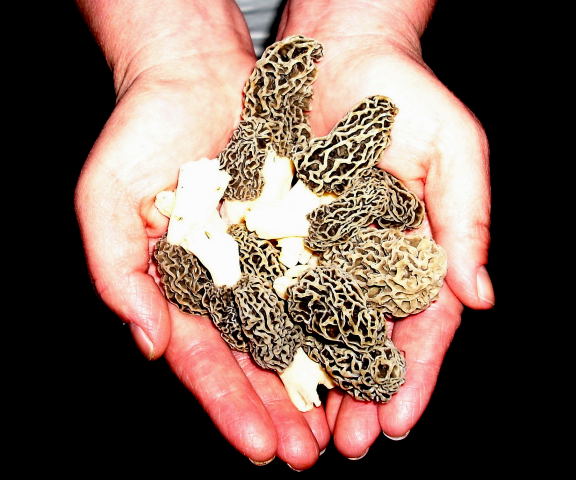
It's morel mushroom season! For a few weeks every spring, these little gifts grow in the woods. I'm lucky enough to have a small mushroom patch on my property. Morels are rare and many mushroom hunters keep their hunting grounds secret. Morels, like many wild mushrooms, cannot be cultivated. Though there are many theories amongst seasoned mushroom hunters, no one understands exactly how the spores are spread, or where exactly they come from. They only grow where the soil, moisture and temperature are perfect.
These picky little morsels taste fantastic. They have an earthy, nutty flavor. Morels can be dehydrated or frozen, but taste best when they are fresh. My little patch doesn't produce many mushrooms, so we just enjoy them while they are in season. Last night I found my first morels of the season. Thirteen little mushrooms were sticking their heads up through the thick leaves. They can be hard to spot and many people have a hard time distinguishing them from the leaves and plants on the ground. I enjoy hunting them; it gives me time alone in the woods and is great "mental floss."
Morels can be put in soups or sauces. A lot of people like to batter and deep fry them, but I think that destroys their great taste. My family's favorite way to prepare them is to lightly saute' them in olive oil and garlic. They are a healthy, tasty treat!!

Tuesday, April 13, 2010
My Square Foot Garden
My 4' x 4' garden box has been assembled!


I placed the garden bed on the south side of our house to get as much sunlight as possible. I also put it right up against the house, in hopes of discouraging deer from dining on my vegetables. The box is made of 1x6 boards, and 1/2x2 boards form the grid. Instead of using topsoil, I mixed together "Mel's Mix," which is suggested in Square Foot Gardening. It's 1/3 peat moss, 1/3 compost and 1/3 vermiculite. This mix is supposed to hold moisture well, without compacting. Vermiculite can be difficult to find, and I had to buy several small bags at Lowes. If anyone knows of a place to buy it in larger bags, let me know!
I planted my cool weather veggies in the new gardening box. I transplanted my sugar snap peas. My lettuce seedlings all died, so I planted more seeds directly in the box, hoping they will grow. I also planted my red onion bulbs. The tomato and pepper seedlings will need to wait for another month or so. Each square in the box is a square foot. Tomato and pepper plants can only be planted one per square. However, peas and lettuce can be planted 4 per square, and the onions 8 per square. The square foot method is supposed to use less space than the traditional method of planting in rows. And because you never walk directly on the soil, you also spend less time working the soil.
I discovered this weekend that our apple tree is blooming. I planted this tree as a seedling and this is the first year that it has put on blooms. It will be interesting to see if it produces anything resembling an apple this year!

Monday, April 12, 2010
Grass-Fed vs. Corn-Fed Beef
This is an interesting story about the health benefits of grass-fed beef. The writer seemed to prefer the taste of corn-fed beef, but found evidence that grass-fed is healthier. My family prefers the taste of grass-fed. It's all a matter of taste!
http://www.npr.org/templates/story/story.php?storyID=125722082&sc=fb&cc=fp
http://www.npr.org/templates/story/story.php?storyID=125722082&sc=fb&cc=fp
Subscribe to:
Posts (Atom)